

What is a PPEC?
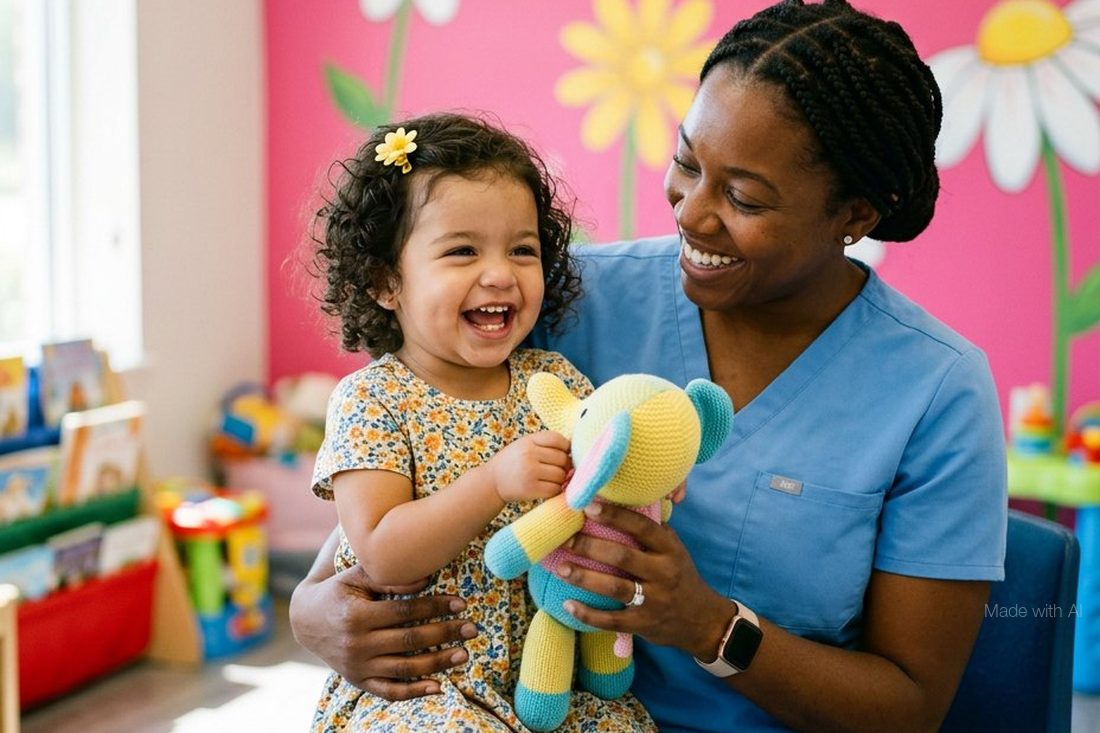
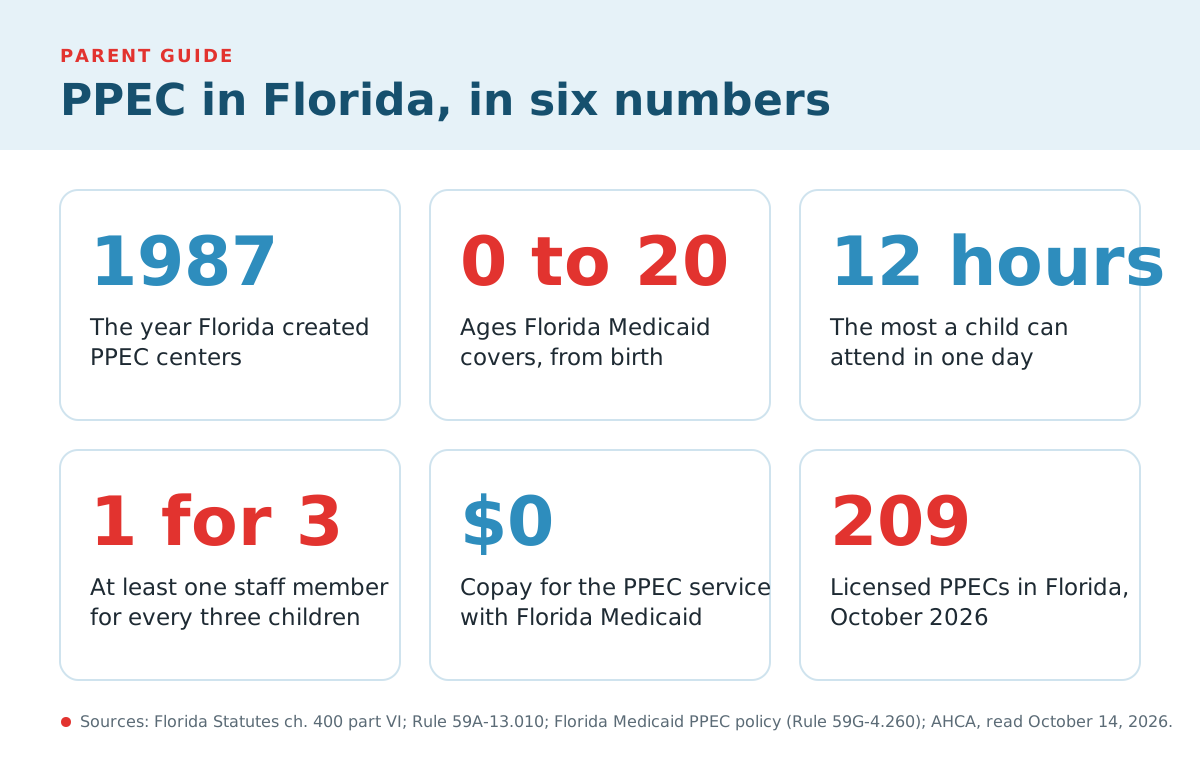
A PPEC is a medical daycare licensed by the state of Florida. Nurses care for children with serious medical needs during the day, for up to 12 hours, and each child goes home at night. A doctor prescribes it, and Florida Medicaid pays for it for children who qualify, with no copay.
If a doctor or a hospital nurse just told you about PPEC, you probably have a lot of questions. This guide answers the ones parents ask most: what a PPEC is, why Florida created it, who it is for, who pays, and how to start.
Talk with your child's doctor about whether PPEC fits your child's needs.
At a glance
- PPEC stands for Prescribed Pediatric Extended Care.
- It is for children with complex medical needs, from birth through age 20 under Florida Medicaid 3.
- A child can attend up to 12 hours a day and goes home every night 1.
- It starts with a referral from your child's doctor, called a prescription in Florida's rule 1.
- For children on Florida Medicaid, there is no copay for the PPEC service 4.
- Florida has 209 licensed PPECs. 19 are in Palm Beach County (October 2026) 5.
What does PPEC mean?
PPEC means Prescribed Pediatric Extended Care. Each word tells you something about the care.
- Prescribed: a doctor orders it, the same way a doctor orders a medicine or a therapy.
- Pediatric: it is only for children.
- Extended care: nurses and therapists care for the child through the whole day.
Florida law calls a PPEC center a place that gives daytime care to children who are "medically dependent or technologically dependent" 1. In plain words, that means a child who needs treatment or nursing care all day. A doctor prescribes that care, and a registered nurse gives it or oversees it 1.
A PPEC is not a hospital and not a nursing home. Children do not sleep there. They come in the morning, get their care, and go home to their families.
Why did Florida create PPEC centers?
Florida created PPEC centers so children with serious medical needs could get nursing care during the day, close to home, while their families keep living their lives. The law was first passed in 1987 1.
The law asks every center to give care that puts the family at the center. In its own words, centers provide "family-centered medical, developmental, physiological, nutritional, psychosocial, and family training services" 1.
That long list comes down to four things a parent cares about:
- Your child gets medical and nursing care all day.
- Your child keeps learning and growing, with therapy and play.
- Your child eats and gets feedings on time.
- You learn how to care for your child at home, from nurses who know your child.
For many families, this is what makes it possible to go to work, care for other children, or rest, knowing a nurse is with their child.
What happens at a PPEC during the day?
Children get nursing care, therapy, meals, play and learning, all in one building. Florida Medicaid requires every PPEC to offer these services 4:
| Service | What it means for your child |
|---|---|
| Nursing | Medicines, tube feedings, breathing treatments and close watch all day |
| Personal care | Help with eating, bathing, changing and moving |
| Developmental therapies | Activities that help your child grow and learn |
| Respiratory therapy | Care for breathing, such as oxygen and suctioning |
| Psychosocial services | Support for your child's feelings and for the family |
| Caregiver training | Nurses teach parents how to give care at home |
| Medical services | Care directed by the center's doctor |
| An escort for rides | The center sends an escort when Medicaid's transportation benefit is used |
Florida sets strict rules for who works there. The medical director must be a board-certified pediatrician 2. The director of nursing must be a Florida registered nurse with at least two years of pediatric nursing 2. There must be at least one staff member for every three children, and about half of the staff must be licensed nurses 2.
Who is PPEC for?
PPEC is for children with complex medical needs who need nursing care all day, are stable enough to leave the hospital, and have a doctor's prescription 2. Florida Medicaid covers children from birth through age 20 3.
Many of these children need things like tube feedings, breathing support, oxygen or a nurse who watches them closely. Some are babies just home from the NICU, the newborn intensive care unit. Others are older children who have needed this care for years.
Two rules surprise parents:
- Only children with medical needs can attend. Florida law does not let a PPEC care for brothers or sisters who do not have medical needs 1.
- Your child must be medically stable. The center's medical and nursing directors decide, with your child's doctor, whether the center can safely care for your child 2.
Read who qualifies for PPEC in Florida for the full list of rules.
How is a PPEC different from a regular daycare?
The biggest difference is the nurses. At a PPEC, nurses give medicines, feedings and treatments all day. A regular daycare is not built for that.
| Regular daycare | PPEC | |
|---|---|---|
| Who can attend | Any child in the age range | Only children with medical needs and a doctor's prescription 1 |
| Who cares for your child | Child care staff | Registered nurses, licensed nurses and trained care staff 2 |
| Medical care | Not the main job | Medicines, feedings and treatments all day 4 |
| License | A child care license | A health care license from AHCA, the state health care agency 1 |
| Who pays | The family, or a child care subsidy | Florida Medicaid, for children who qualify 4 |
Who pays for PPEC?
For children on Florida Medicaid, Medicaid pays for PPEC and there is no copay for the service 4. The center asks Medicaid to approve the care first, and the approval is renewed every 180 days 4.
A few details are good to know:
- Children in any Florida Medicaid plan can attend. Florida Medicaid pays the center directly, even if your child is in a Medicaid health plan 6.
- Rides come from a separate Medicaid benefit. Medicaid covers rides to and from the center through its transportation benefit, and Florida's Medicaid rules require the center to send an escort 4.
- Some families pay a share first. If your child is on Florida's Medically Needy program, you may owe a monthly share of cost before Medicaid pays 7.
- No Medicaid? Call us to ask about other ways to pay.
Read does Florida Medicaid pay for PPEC? for the full answer.
How do we start?
You can start with one phone call. Here are the steps most families follow:
- Call us at (561) 877-2152. We answer your questions and tell you what comes next.
- Your child's doctor writes the PPEC referral, called a prescription in Florida's rule 1. You can call before you have one.
- We plan your child's care with you before the first day. If your child is in the hospital, the hospital team is part of the plan 2.
- The center asks Florida Medicaid for approval, called prior authorization 4.
- First day. Parents get a full welcome and training at the start 2.
Read how to enroll in PPEC, step by step to see each step in detail.
Is there a PPEC near me in Palm Beach County?
Yes. Palm Beach County has 19 licensed PPECs, according to the state's list in October 2026 5. Superhero Kids PPEC in Boynton Beach is the largest one in the county, licensed for 82 children 5.
- Where: Boynton Beach, Palm Beach County
- Hours: Monday to Saturday, 7 am to 7 pm
- Ages: birth through age 20
- License: Florida AHCA license 60081108
- Rides: for children with Medicaid, through Medicaid's transportation benefit, with an escort the rules require. Call to ask how rides work for your child.
Call (561) 877-2152. Open Monday to Saturday, 7 am to 7 pm.
Questions parents ask
Is a PPEC a school?
No. A PPEC is a licensed health care center. Children do play, learn and get therapy there, but a PPEC does not replace school.
Can my child go to school and a PPEC on the same day?
Florida's PPEC rules do not stop a child from going to both 4. The hours your child can attend are set in the Medicaid approval. Talk with us and your child's school about how the day can fit together.
Can my child's brother or sister come too?
No. Florida law lets a PPEC care only for children who have medical needs 1.
Is a PPEC the same as a hospital?
No. Children do not stay overnight. A child must be stable enough to leave the hospital before starting at a PPEC 2.
Do other states have PPECs?
Yes. A few other states have similar centers, sometimes under other names. They include Texas, Pennsylvania and Kentucky 8.
Keep reading
- Who qualifies for PPEC in Florida?
- Does Florida Medicaid pay for PPEC?
- PPEC or nursing at home: how to choose
- How to enroll in PPEC, step by step
Sources
- Florida Statutes, Part VI of Chapter 400, sections 400.901, 400.902 and 400.914. Read October 14, 2026. https://www.flsenate.gov/Laws/Statutes/2025/400.902
- Florida Administrative Code, Chapter 59A-13, rules 59A-13.007, 59A-13.009, 59A-13.010 and 59A-13.013. Read October 14, 2026. https://www.flrules.org/gateway/ChapterHome.asp?Chapter=59A-13
- Agency for Health Care Administration, Prescribed Pediatric Extended Care (PPEC). Read October 14, 2026. https://ahca.myflorida.com/medicaid/child-health-services/prescribed-pediatric-extended-care-ppec.html
- Florida Medicaid, Prescribed Pediatric Extended Care Services Coverage Policy, February 2018, adopted in Rule 59G-4.260. Read October 14, 2026. https://www.flrules.org/gateway/RuleNo.asp?ID=59G-4.260
- Agency for Health Care Administration, FloridaHealthFinder facility locator, PPEC centers. Counted October 14, 2026. https://quality.healthfinder.fl.gov/Facility-Provider/PPECC?&type=1
- Florida Statutes, sections 409.968(3) and 409.972(1)(g). Read October 14, 2026. https://www.flsenate.gov/Laws/Statutes/2025/409.968
- Florida Department of Children and Families, Economic Self-Sufficiency questions (Medically Needy share of cost). Read October 14, 2026. https://www.myflfamilies.com/services/public-assistance/economic-self-sufficiency-frequently-asked-questions/
- Texas Health and Human Services, Prescribed Pediatric Extended Care Centers; Pennsylvania Department of Health, Pediatric Extended Care Centers; Kentucky regulation 902 KAR 20:280. Read October 14, 2026. https://www.hhs.texas.gov/providers/long-term-care-providers/prescribed-pediatric-extended-care-center-ppecc